Eterna Global Solutions
C-52 Block-C, Sector 80
Noida Uttar Pradesh,
201306, India
Eterna Global Solutions
C-52 Block-C, Sector 80
Noida Uttar Pradesh,
201306, India

Eterna Global Solutions LLP provides Design for Manufacturing (DFM) engineering as a core capability — not an afterthought. Every product that enters our NPI process or OEM contract manufacturing program begins with a DFM review conducted by engineers who operate the same laser cutters, press brakes, welding stations, and coating line that will manufacture the product. This is DFM by practitioners, not theorists — every recommendation is backed by direct knowledge of what our machines can and cannot do, what our tolerances actually achieve, and where real production problems occur.
DFM is the discipline of reviewing a product design before manufacturing begins and modifying it to be easier, cheaper, faster, and more reliable to produce — without compromising the product’s functional performance. A well-designed enclosure and a poorly-designed enclosure can meet the same functional specification, but the well-designed one costs 15–30% less to manufacture, produces fewer rejects, assembles faster, and reaches your customer sooner. The difference is almost always in details that only a manufacturer notices: a bend too close to a hole that distorts during forming, a weld joint that requires an awkward fixture, a panel that wastes 40% of the sheet because the designer didn’t consider standard stock sizes, a tolerance that is ten times tighter than the function requires.
Our DFM engineering service catches these issues at the drawing stage — when a change costs nothing more than a CAD revision — rather than discovering them on the shop floor when the cost of change is 10× to 100× higher. We provide this review at no charge during the quotation stage for every new product enquiry, because it saves both of us time, money, and frustration throughout the production lifecycle.
In sheet metal manufacturing, the cost of correcting a design error multiplies at every stage. Fixing a hole position in CAD takes 30 seconds. Fixing the same hole after laser cutting requires scrapping the blank. After forming, the entire part is scrap because the bend sequence has already committed the geometry. After welding, the assembly is scrap. After powder coating, you’ve also wasted coating material and oven time. After assembly and IP testing, you’ve wasted every resource the factory has. DFM catches these problems at the only stage where the fix is free: the drawing.
Most DFM advice available online or from design consultancies is generic. It tells you “minimum bend radius should be equal to material thickness” without telling you that our press brakes with our tooling on this specific material actually achieve a tighter radius reliably, or that a particular radius is problematic because of springback behaviour on Indian-mill CRC. Eterna’s DFM is specific to our equipment, our materials, our processes, and our operators. When we say a feature is feasible, it’s because we’ve made it on the machines that will make your product. When we flag a risk, it’s because we’ve seen the failure mode on the same equipment.
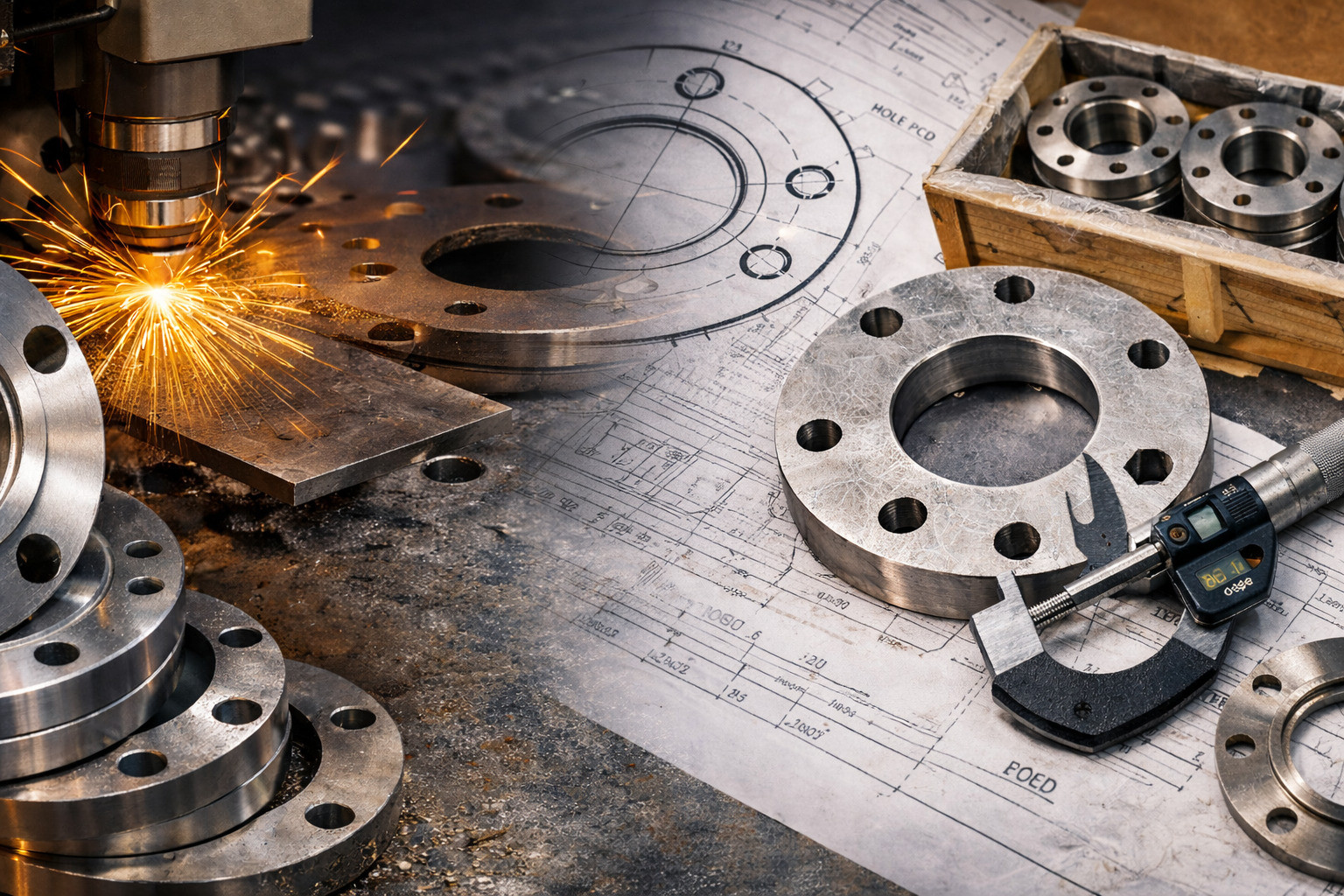
How the flat blank is cut from the sheet directly impacts material cost, edge quality, and downstream process behaviour.
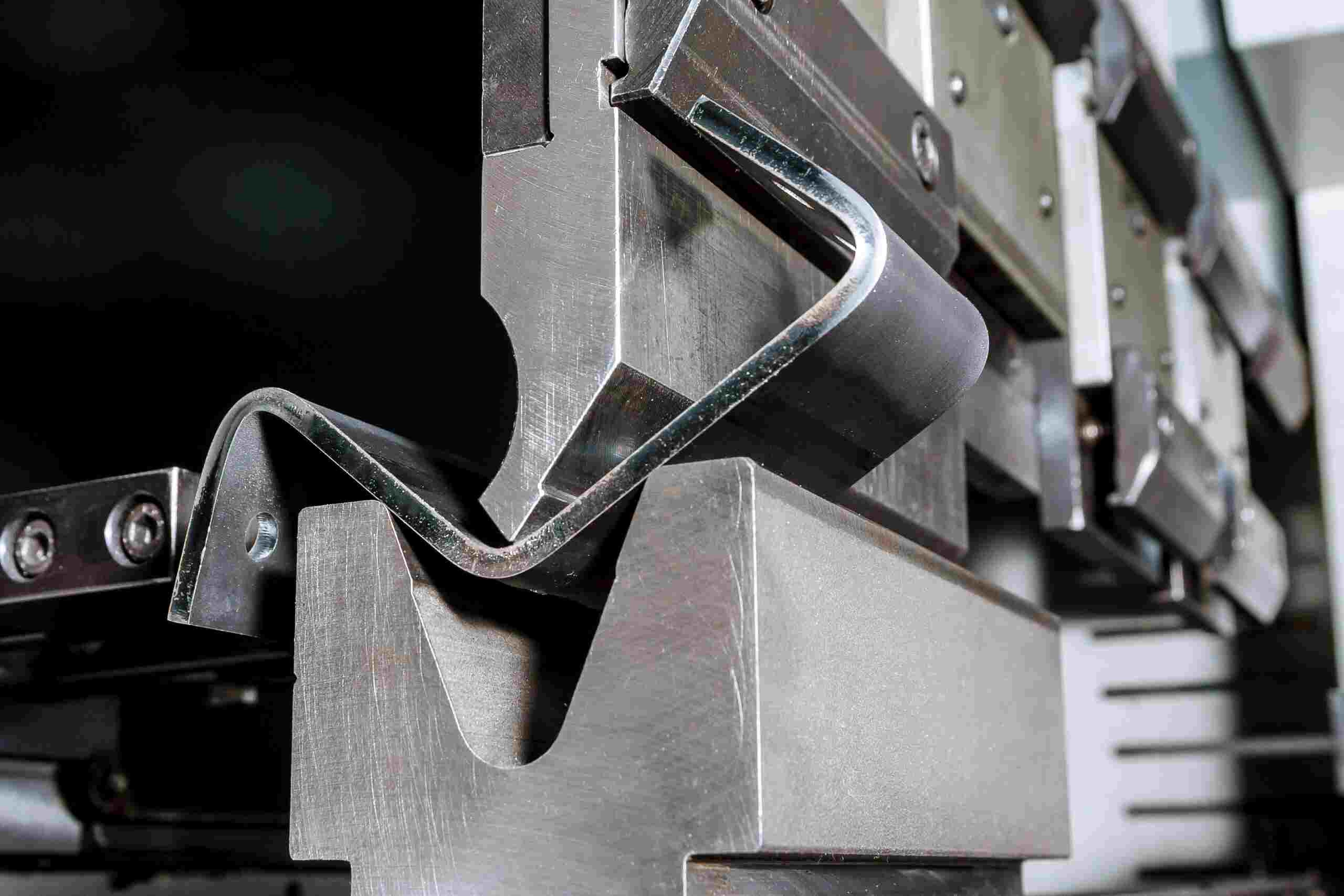
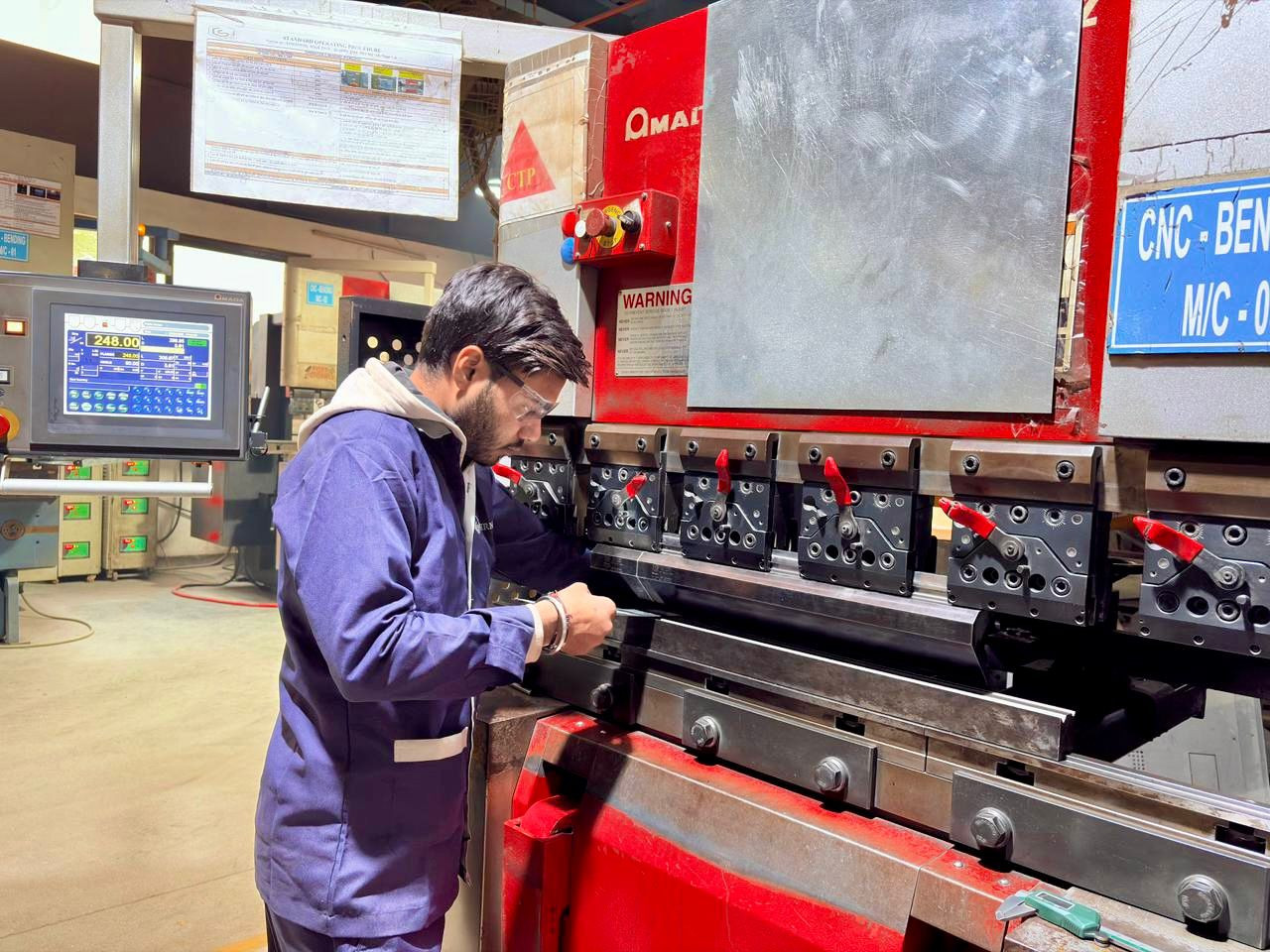
Forming is where most DFM issues hide. A design that looks perfect in CAD can be impossible to bend without collisions, distortion, or tolerance failure on a real press brake.
Weld joint design directly affects production speed, fixture complexity, distortion, and the cosmetic quality of the finished product.
DFM extends beyond fabrication into hardware insertion, surface finishing, and final assembly.
Minimum internal bend radius: 1.0× material thickness for CRC/GI, 1.5× for stainless steel, 2.0× for aluminium alloys (5052/6061). Tighter radii risk cracking on the outer bend surface.
Minimum hole-to-bend distance: 2.5× material thickness + bend radius, measured from hole centre to bend tangent point. Closer = distortion of the hole during forming. Add a relief slot if the hole must be closer.
Minimum flange length: 4× material thickness as a general minimum. Below this, the press-brake die cannot grip the flange reliably, causing inconsistent bend angles.
Bend relief: At corners where two bends meet, provide a relief cut or notch equal to material thickness in width and extending past the bend line by at least 1 mm. Missing relief = tearing at the corner.
Maximum bend length: Limited by press-brake bed length. Our press brakes handle up to 3,100 mm. Longer bends require splicing or alternative forming methods.
Minimum hole diameter (laser): 0.5× material thickness (e.g., 0.5 mm minimum on 1.0 mm sheet). Smaller holes may not cut cleanly or may close during forming if near a bend.
Minimum feature spacing: Keep holes, slots, and edges at least 2× material thickness apart. Closer spacing weakens the web between features and may cause deformation during cutting or forming.
Weld joint minimum gap: 0.5–1.0 mm gap between parts to be butt-welded provides proper fusion. Zero-gap butt joints risk incomplete penetration. Lap joints should overlap by at least 3× material thickness.
PEM nut minimum material thickness: The parent sheet must be thick enough for the PEM clinch to hold. Typical minimum: 1.0 mm for M3 PEM nuts, 1.2 mm for M4, 1.5 mm for M5, 2.0 mm for M6. Thinner sheets = unreliable pull-out strength.
Powder coat masking: Allow a minimum 3 mm clearance around features that will be masked (threads, mating surfaces). Tighter clearance makes accurate masking difficult and increases the risk of coating creep into masked areas.
Standard vs special: Wherever possible, design to standard Indian-mill sheet thicknesses (0.8, 1.0, 1.2, 1.5, 2.0, 2.5, 3.0 mm for CRC; 0.8, 1.0, 1.2, 1.6, 2.0 mm for GI) and standard sheet sizes. Non-standard thicknesses require special-order mill runs with MOQ, lead time, and price premium.
Material grade matching: Specify the actual material grade (IS 513-D for CRC, IS 277 for GI, AISI 304 or 316 for SS) rather than generic “mild steel” or “stainless steel”. Different grades within the same family have different formability, springback, and weldability characteristics that affect DFM decisions.
Don’t over-tolerance: Specifying ±0.05 mm on a non-critical enclosure dimension that only needs ±0.5 mm drives up inspection cost, increases reject rates, and slows production without any functional benefit. Our DFM review identifies over-toleranced features and recommends realistic tolerances matched to function.
Achievable tolerances: Laser cutting ±0.10 mm, CNC forming ±0.15–0.20 mm per bend, accumulated multi-bend parts ±0.30–0.50 mm overall, welded assemblies ±0.50–1.0 mm depending on size and complexity. We specify achievable tolerances for every feature so your drawing reflects manufacturing reality.
You send your design files
3D model + 2D drawing + BOM + functional context
Share your product files along with a brief description of the product’s function, deployment environment, volume expectations, and any specific concerns you have about manufacturability.
Our engineers review every feature
Cutting • forming • welding • hardware • coating • assembly
Our DFM engineers systematically review every feature of the design against our process capabilities, tooling inventory, and material behaviour knowledge.
Written DFM report delivered
Categorised findings • solutions • cost impact
You receive a written DFM report with every finding documented, categorised, and accompanied by a proposed solution.
Review call and design lock
Discuss findings • approve/reject each • revise drawing • proceed to NPI
We walk through the DFM report with your engineering team (call, video, or in-person at our facility) to discuss each finding, answer questions, and agree on which recommendations to implement.
Sheet utilisation improvement: Adjusting a panel dimension by 5–15 mm to improve nesting efficiency on standard sheet sizes can increase material yield by 10–20%. On a 1,000-unit production run of a 2 mm CRC enclosure, a 15% yield improvement can save £50,000–1,50,000 in raw material alone.
Thickness rationalisation: Replacing a 2.0 mm panel with 1.5 mm where structural analysis confirms adequacy saves 25% material weight and cost per panel. Multiplied across all panels in a cabinet and across production volumes, this is one of the most impactful DFM changes available.
Standard stock sizes: Designing to standard Indian-mill sheet sizes eliminates wasteful trimming from oversized stock and avoids the lead time and price premium of special-order sheets.
Part consolidation: Combining two or more welded parts into a single formed part eliminates weld joints, welding labour, grinding, and the associated distortion and quality risk. A part that was three pieces welded together can often become one laser-cut-and-bent piece with no functional compromise.
Simplified forming: Reducing the number of bends, eliminating compound bends, or redesigning a flange to avoid a collision-prone sequence can cut forming time by 30–50% per part.
Reject rate reduction: Eliminating features that are near process limits (tight radii, close-tolerance holes near bends, difficult weld access) reduces the percentage of parts that fail inspection, cutting scrap cost and rework time.
Assembly time reduction: Self-locating tab-and-slot joints, standardised fastener sizes, improved access for assembly tools, and logical assembly sequencing can reduce total assembly time per unit by 15–25%.
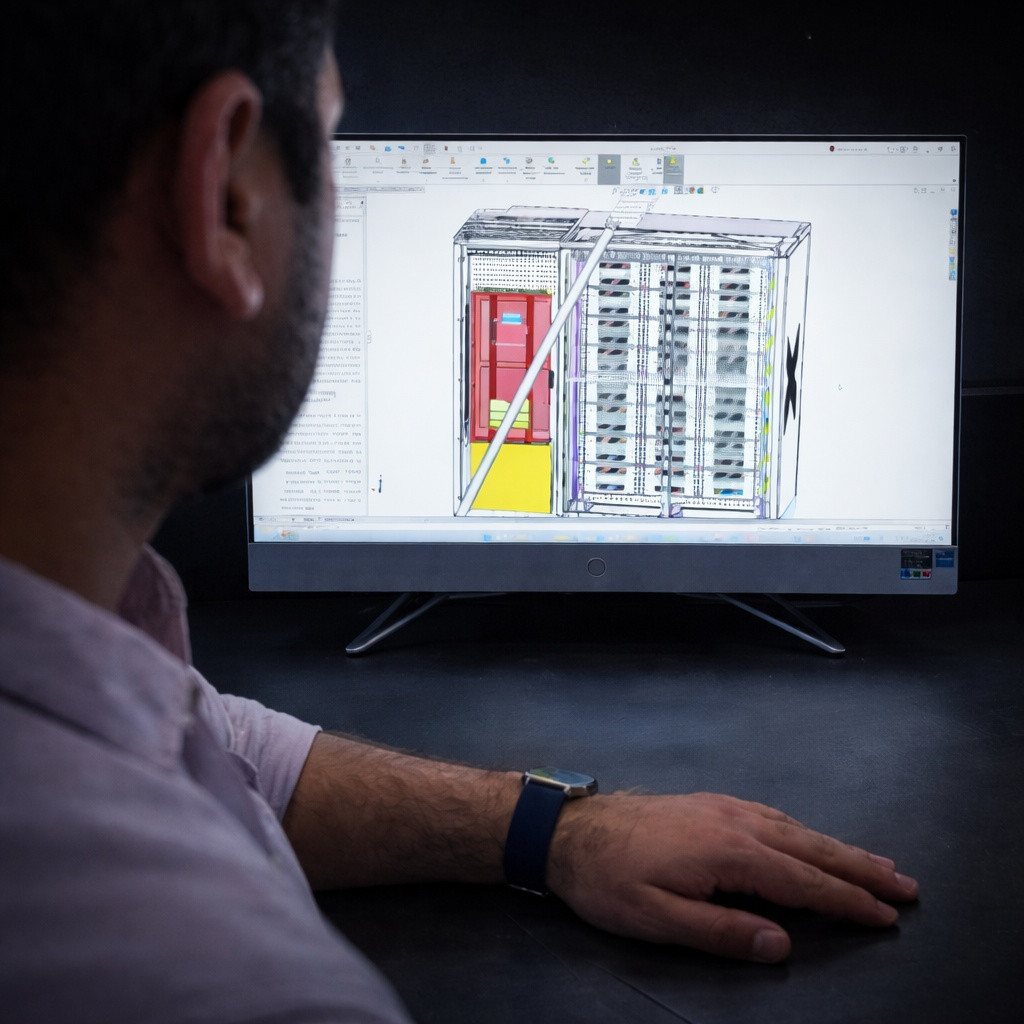
SolidWorks: Primary 3D CAD platform for design review, flat-pattern development, assembly verification, and DFM analysis. We work natively in SolidWorks and can open/edit your SolidWorks files directly.
AutoCAD: For 2D drawing review, DXF/DWG laser-cutting file preparation, and annotation of DFM findings on your existing 2D drawings.
STEP/IGES import: Universal format support for receiving designs from any CAD platform (Creo, CATIA, Inventor, Fusion 360, NX, etc.).
Sheet metal flat pattern: Flat patterns developed using our measured K-factor and bend deduction tables specific to each material/thickness combination on our press brakes — not generic CAD-default values that produce inaccurate blanks.
Nesting software: Automatic and manual nesting of flat patterns on standard sheet sizes to estimate material utilisation during DFM review. This allows us to quantify the material cost impact of dimension changes precisely.
Press-brake bend simulation: Bend sequence verification with collision detection for our specific machine geometry and tooling inventory, ensuring every bend is physically achievable before the part reaches the shop floor.
Weld fixture planning: Conceptual fixture layout developed during DFM to anticipate fixturing requirements and flag design features that create fixturing problems.
Documentation: DFM reports generated with annotated screenshots from CAD, marked-up drawings, and tabulated measurement data. Reports are delivered as PDF for universal accessibility.
Send your 3D model or 2D drawing — we return a detailed DFM report within 3–5 working days.