Eterna Global Solutions
C-52 Block-C, Sector 80
Noida Uttar Pradesh,
201306, India


Eterna Global Solutions
C-52 Block-C, Sector 80
Noida Uttar Pradesh,
201306, India
Eterna Global Solutions LLP maintains an organised, traceable procurement system for every material and component that goes into the products we manufacture. Sheet metal, fasteners, gaskets, locks, hinges, cable glands, powder coat, electrical components — every item on the Bill of Materials is sourced from established suppliers, verified at incoming inspection, and linked to the production batch through our traceability system. This matters because the quality of a finished enclosure starts with the quality of the material it’s made from.
In the Indian sheet metal fabrication industry, material sourcing is often the weakest link. Shops buy the cheapest sheet available on a given day, from whichever dealer offers the lowest rate, without checking the grade, without verifying thickness, and without obtaining a Mill Test Certificate. The result is unpredictable: some batches bend well, others crack; some batches weld cleanly, others are porous; some batches coat well, others delaminate in the field. The root cause is the same every time — unknown or inconsistent material entering the production floor.
CRC is the workhorse material for sheet metal enclosures — good formability, clean weld behaviour, excellent powder coat adhesion, and competitive pricing.
Pre-galvanised sheet provides a zinc corrosion barrier underneath the powder coat, making it the standard material for outdoor enclosures deployed in Indian climate conditions.
Stainless steel for applications where corrosion resistance must outlast any coating system — coastal sites, chemical plants, food processing, pharmaceutical, and high-end visible installations.
Aluminium for weight-sensitive applications and copper for electrical components manufactured as part of integrated enclosure assemblies.
PEM fastening hardware: Clinch nuts (CLS, CLSS for stainless), clinch studs (FH, FHS), clinch standoffs (SO, SOS), and broaching hardware. PEM is our standard for blind-side threaded fastening in sheet metal. Sourced from authorised PEM distributors in India. Thread sizes M3 through M10 in stock sizes; specials ordered per BOM.
Locks and latches: Cam locks, swing handles, multi-point espagnolette locks, and padlockable handles for enclosure security. Sourced from EMKA, Lowe & Fletcher, and Indian equivalents depending on the product specification and price point.
Hinges: Continuous piano hinges, concealed hinges, and detachable hinges. Stainless or zinc-plated per application. Hinge selection coordinated with door weight and IP sealing requirements.
Cable glands: IP68-rated nylon and metallic cable glands from Hummel, Lapp, Comet, and equivalent Indian brands. Selected per cable diameter and IP requirement. Blanking plugs for unused entries.
Gaskets: EPDM closed-cell foam, solid EPDM, and silicone gaskets in standard and custom profiles. Sourced from established gasket manufacturers.
MCBs and RCCBs: Miniature circuit breakers and residual current devices from Schneider Electric, Havells, ABB, Siemens, or L&T — specified per your design requirements and approved per BOM.
Busbars and earth bars: Copper busbars fabricated in-house from ETP copper flat bar per IS 191. Tin-plated busbars available. Earth bars with brass studs and insulating supports.
Surge protection (SPDs): Sourced per specification from standard electrical suppliers. Type 1, Type 2, and combined Type 1+2 available.
Fans and filters: Panel fans (Rittal, Stego, Indian equivalents) with filter assemblies for ventilated enclosures. Thermostat-controlled activation.
DIN rail and accessories: Standard 35 mm DIN rail, terminal blocks, cable ducts, and wiring accessories for control panel and electrical enclosure interiors.
Powder coat: Outdoor polyester powder from Interpon (AkzoNobel), Asian Paints PPG, Jotun, or Tiger. Standard RAL colours stocked by our coating suppliers; custom colours available with minimum order. Coating procurement managed as part of the production BOM, not an afterthought.
Mill Test Certificate (MTC): Every sheet metal delivery is accompanied by an MTC from the mill or stockist. We verify the MTC lists the correct grade (IS 513-D, IS 277, AISI 304/316 as specified on the BOM), chemical composition within specification, and mechanical properties (yield strength, tensile strength, elongation) per the relevant standard.
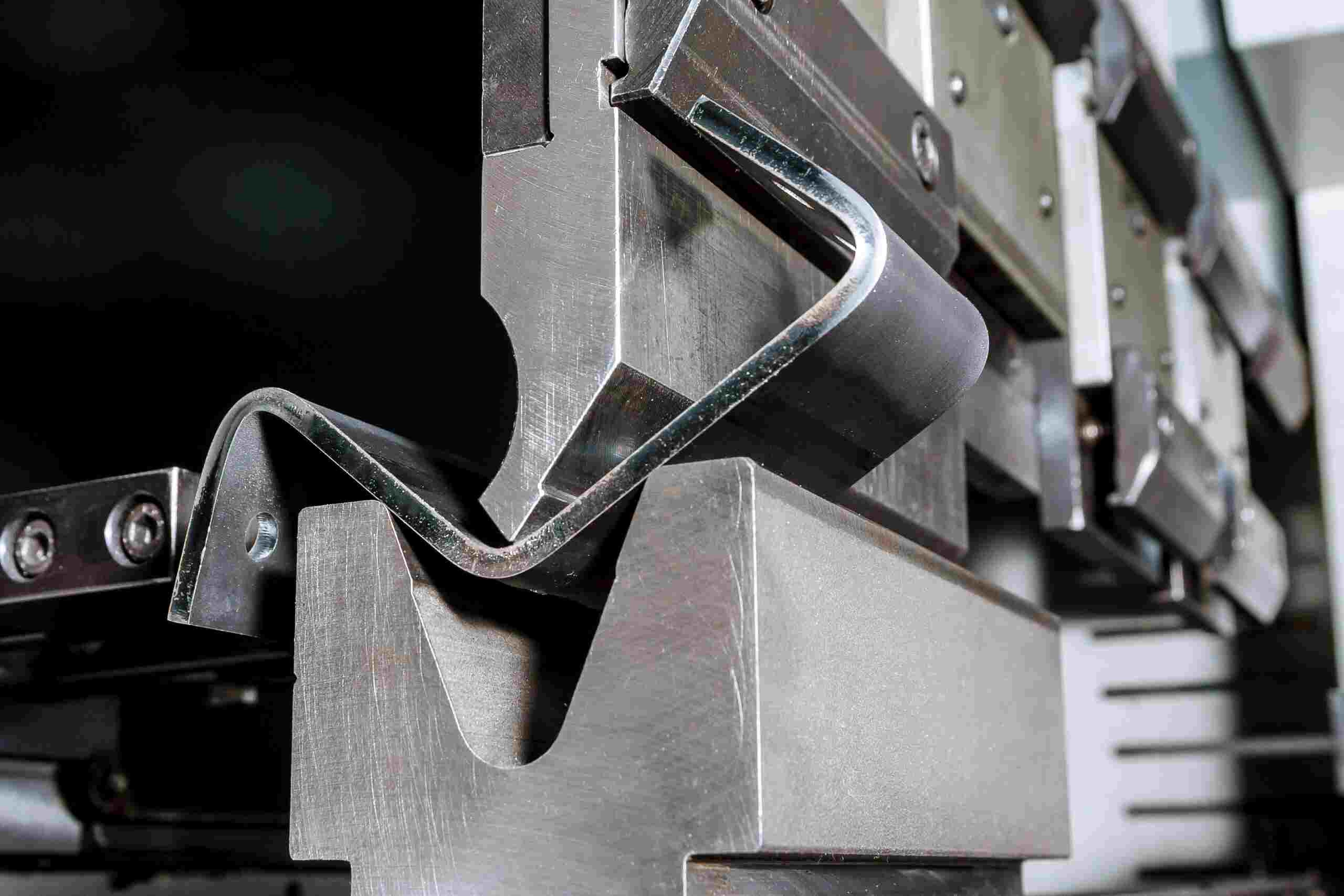
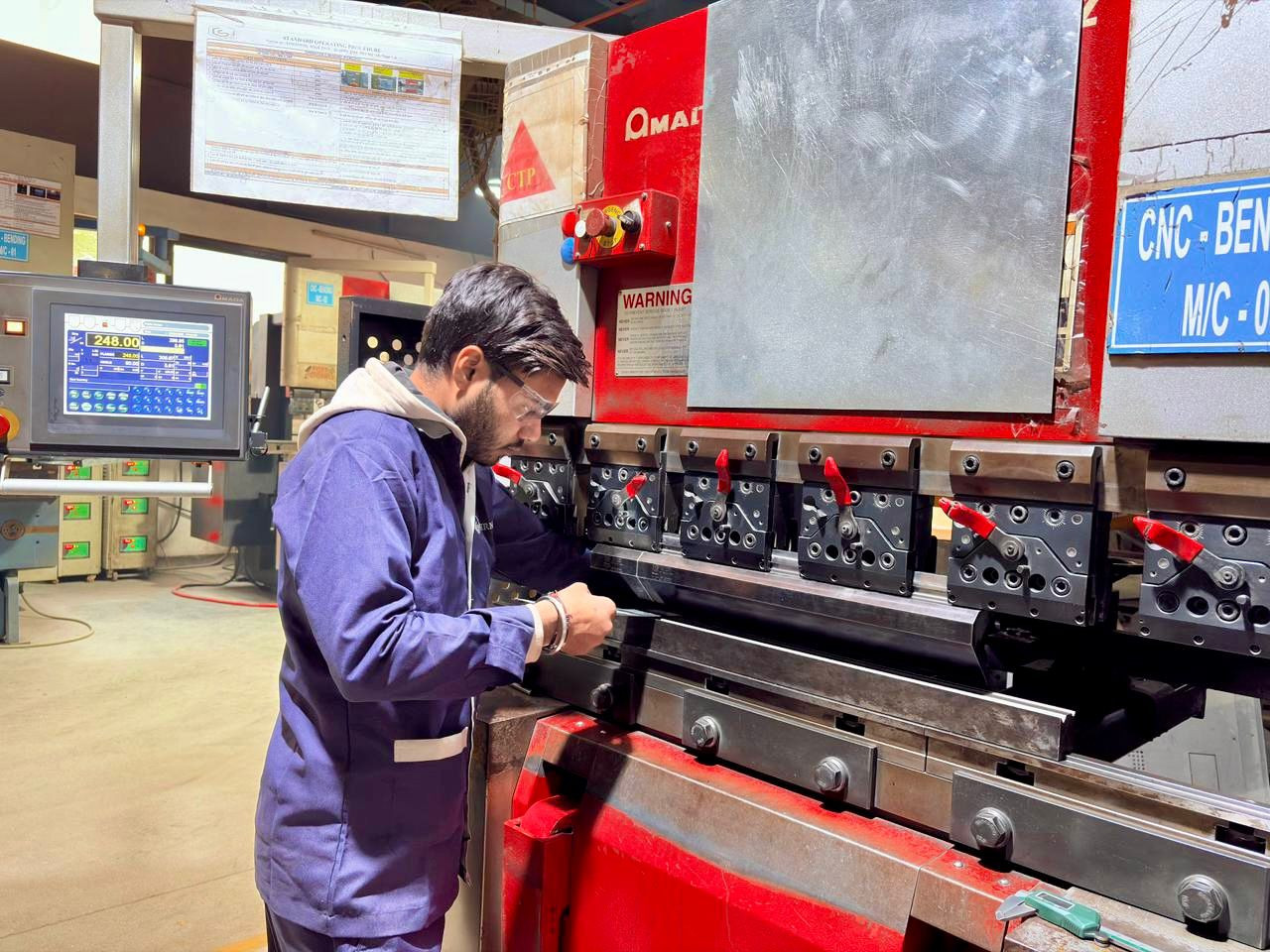
Thickness verification: Sheet thickness spot-checked with a calibrated micrometer at multiple points across the sheet. Indian-mill sheet can vary within the standard tolerance band (±0.05 mm for CRC, wider for GI). We verify that incoming material is within the range our bend calculations and springback compensation are calibrated for. If material is at the edge of tolerance, the press-brake operator is notified to adjust accordingly.
Surface condition: Visual inspection for rust spots, oil stains, zinc coating defects (on GI), scratches, dents, and edge damage. Defective sheets are rejected or segregated for non-critical use (e.g., internal brackets where cosmetics are irrelevant).
Correct part number: Delivered components verified against the purchase order and BOM — right brand, right part number, right quantity.
Visual and functional: Locks checked for smooth operation, cable glands checked for correct thread and seal, PEM hardware checked for correct size and thread. Gaskets checked for correct profile, durometer (hardness), and length.
Electrical components: MCBs verified for correct rating (amps, poles, curve type). Busbars verified for correct cross-section and length. Wiring checked for correct gauge and colour.
Powder coat: Incoming powder checked for correct RAL number, texture type (smooth/fine texture/wrinkle), and gloss level. Stored in climate-controlled conditions to prevent moisture absorption, which causes coating defects.
Material receipt → production batch: When sheet metal arrives, it is assigned an internal material batch number linked to the supplier’s MTC. When that material is issued to a production order, the material batch number is recorded against the production batch.
Production batch → serial number: Finished products carry a serial number assigned during assembly. The serial number links back to the production order, which links to the material batch, which links to the MTC. This chain is maintained in our production records.
Result: Given any finished product serial number, we can retrieve: the material grade and MTC, the material supplier, the production date, the assembler and inspector IDs, the coating batch and DFT readings, and the IP test result (for IP-rated products).
Field failure investigation: If a product issue is reported from the field, traceability allows us to determine whether it is a material issue, a process issue, or a design issue — and whether other units from the same batch may be affected. Without traceability, every investigation is a guessing game.
Customer audits: Enterprise procurement teams and international buyers routinely ask for material traceability as a vendor qualification requirement. Having it in place demonstrates organised manufacturing and enables confident answers during audit reviews.
Regulatory and compliance: For products deployed in regulated sectors (telecom infrastructure, power distribution, defence), material traceability is often a contractual requirement. Our system satisfies this requirement without special setup — it is how we operate for every product.
BOM drives procurement
Every item specified • no ad-hoc buying
Every product at Eterna has a locked BOM that lists every material and component with exact specifications: material grade, thickness, sheet size, supplier, part number for hardware components, and approved alternatives where applicable.
Established supplier relationships
Delhi NCR stockists • known quality • repeat sourcing
We procure from established stockists and distributors in the Delhi NCR region with whom we have ongoing commercial relationships.
Standard and advance procurement
2–5 day standard • pre-booking for volume programs
For individual production orders, material is procured per PO with standard lead time. For recurring volume programs, procurement is aligned with your delivery forecast to reduce batch lead time.
Customer-supplied material
You supply • we fabricate • traceability maintained
Some OEMs prefer to supply their own material — either because they have a preferred mill source, a negotiated price agreement, or a specific grade requirement that we don’t normally stock.
Share your product specification — we confirm material availability, grades, and sourcing approach within 48 hours.





-20082508144130.jpg)
-20082508385589.jpg)


-29112509574730.jpg)
-18122502213226.png)